The Mystery of Wiltshire’s Nine Mile River
For locals in Salisbury, Amesbury, and Bulford looking for an off-the-beaten-path walk, this "Cinderella chalkstream" provides a fascinating glimpse into the unique geology and history of our region.
April 11, 2026 16:38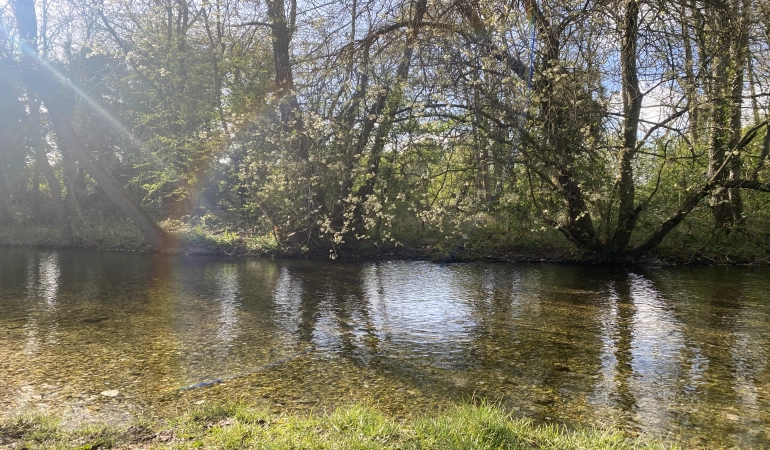
Wiltshire is a county defined by its chalk streams, ancient monuments, and the vast, rolling expanse of Salisbury Plain.
Yet, tucked away near the eastern edge of the Plain lies a lesser-known waterway that holds a curious secret in its very name.
The Nine Mile River is a quiet, unassuming tributary of the River Avon, offering a tranquil escape for walkers and history enthusiasts alike. But there is a catch: the Nine Mile River is not nine miles long.
The Name Mystery: Why "Nine Mile"?
The most immediate question any visitor asks is how a river measuring approximately four and a half miles in length earned the name "Nine Mile River." The answer lies not in its span, but in its relationship to our cathedral city.
- Historians and local geographers propose two main theories for the name. The first suggests that in the days of horse-drawn carts, travellers heading north from Salisbury through Bulford would first cross this river exactly nine miles into their journey.
- The second theory posits that the river earns its title because its confluence with the River Avon at Bulford occurs exactly nine miles upstream from Salisbury.
- Whichever theory you prefer, the river's identity is inextricably linked to the historic routes radiating from Salisbury
A River of Seasons: The Wiltshire Winterbourne
The Nine Mile River is what is known as a winterbourne a stream that flows only after heavy winter rainfall has sufficiently raised the local water table.
- Its headwaters rise from springs below Brigmerston and Figheldean Downs, near the Brigmerston plantation.
- During the dry summer months, the upper reaches of the riverbed are often completely dry, revealing a bed of flint gravels rolled downstream by winter torrents.
- However, when the winter rains soak the chalky downs, the river springs to life. The landscape here contrasts sharply with the typical dry, white-grassed expanses of central Salisbury Plain. Instead, the Nine Mile River valley is a damper, "quaggy" environment, characterised by lush, squelchy, and springy green tufts
- The river's gradient is incredibly gentle, falling only about 20 metres over its entire four-and-a-half-mile course.
- This lack of rapids ensures a slow, meandering flow that eventually meets the River Avon at Bulford.
Ecological Importance and the "Cinderella Chalkstream"
Despite its modest size and seasonal nature, the Nine Mile River plays a vital role in the local ecosystem. A 2006 advisory report by the Wild Trout Trust affectionately referred to it as a "Cinderella Chalkstream" habitat
- When water levels permit, the river boasts excellent instream gravel quality, providing ideal spawning grounds for Brown Trout (Salmo trutta) and sticklebacks
- However, the river is highly sensitive to environmental changes. It is vulnerable to both drought and local water abstraction, with nearby pumping stations occasionally impacting its flow
- Conversely, during periods of intense rainfall, the river and the upper Avon valley are known areas for groundwater flooding, a reminder of the powerful natural forces at play beneath the chalk
Walking the Route: History Beneath Your Feet
For those looking to explore the Nine Mile River, the route offers a journey through both natural beauty and deep history. Because the river flows through the Salisbury Plain Training Area (SPTA), walkers must stick to public rights of way and heed military notices
.
As you follow the shallow valley, you will encounter several notable landmarks:
Landmark | Description |
The Fords | Several tracks ford the river. The most notable crosses the old Marlborough to Salisbury road. Even in summer, this ford can hold surprisingly deep water . |
Ancient Tumuli | The river passes close to numerous historical monuments. Near the approach to Bulford, walkers can spot a large group of nearly twenty ancient burial mounds (tumuli) . |
The Historic Milestone | An intriguing old milestone along the route not only marks the distances to Salisbury and Marlborough but also bears faint, weathered text relating to Hungerford and Sidbury Hill . |
The One-Way Byway | The old road to Bulford, which follows the river closely, is now a byway. Years of use have worn it into a trench-like path. It is affectionately known as perhaps the only "one-way byway" in Wiltshire, as vehicles can only practically travel west along it . |
Bulford Leas | As the river nears Bulford, it passes under Sheep Bridge and enters Bulford Leas, a heavily wooded, "bosky" area where the ground remains perpetually damp . |
A Perfect Weekend Stroll
The Nine Mile River eventually runs behind the houses on the Old Coach Road in Bulford before passing under the High Street bridge and complicating into various channels as it joins the Avon.
- For residents of Salisbury and the surrounding villages, a walk along the Nine Mile River offers a perfect blend of mystery, ecology, and history.
It is a reminder that in Wiltshire, even the smallest streams have a story to tell. Next time there is a wet winter, pull on your wellies and head up to Bulford to see this hidden winterbourne in all its flowing glory.
User Comments (0)





Recommended for you.

Recommended for you.

Recommended for you.